
Abstract
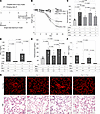
Mutation studies of plasminogen activator inhibitor 1 (PAI-1) have previously implied that PAI-1 promotes lung fibrosis via a vitronectin-dependent (VTN-dependent) mechanism. In the present study, employing 2 distinct murine fibrosis models and VTN-deficient mice, we found that VTN is not required for PAI-1 to drive lung scarring. This result suggested the existence of a profibrotic interaction involving the VTN-binding site on PAI-1 with an unidentified ligand. Using an unbiased proteomic approach, we identified sortilin-related receptor 1 (SorLA) as the most highly enriched PAI-1 binding partner in the fibrosing lung. Investigating the role of SorLA in pulmonary fibrosis demonstrated that deficiency of this protein protected against lung scarring in a murine model. We further found that SorLA is required for PAI-1 to promote scarring in mice, that both SorLA and PAI-1 protein levels are increased in human idiopathic pulmonary fibrosis (IPF) explants, and that these proteins are associated in IPF tissue. Finally, confocal microscopy showed that expression of SorLA in CHO cells increased cellular uptake of PAI-1, and these proteins colocalized in the cytoplasm. Together, these data elucidate a mechanism by which the potent profibrotic mediator PAI-1 drives lung fibrosis and implicate SorLA as a potential therapeutic target in IPF treatment.
Authors
Thomas H. Sisson, John J. Osterholzer, Lisa Leung, Venkatesha Basrur, Alexey Nesvizhskii, Natalya Subbotina, Mark Warnock, Daniel Torrente, Ammara Q. Virk, Sergey S. Gutor, Jeffrey C. Horowitz, Mary Migliorini, Dudley K. Strickland, Kevin K. Kim, Steven K. Huang, Daniel A. Lawrence
This file is in Adobe Acrobat (PDF) format. If you have not installed and configured the Adobe Acrobat Reader on your system.
Having trouble reading a PDF?
PDFs are designed to be printed out and read, but if you prefer to read them online, you may find it easier if you increase the view size to 125%.
Having trouble saving a PDF?
Many versions of the free Acrobat Reader do not allow Save. You must instead save the PDF from the JCI Online page you downloaded it from. PC users: Right-click on the Download link and choose the option that says something like "Save Link As...". Mac users should hold the mouse button down on the link to get these same options.
Having trouble printing a PDF?
- Try printing one page at a time or to a newer printer.
- Try saving the file to disk before printing rather than opening it "on the fly." This requires that you configure your browser to "Save" rather than "Launch Application" for the file type "application/pdf", and can usually be done in the "Helper Applications" options.
- Make sure you are using the latest version of Adobe's Acrobat Reader.


