
Abstract
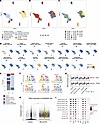
Systemic sclerosis (SSc) is characterized by fibrosis and vasculopathy affecting the skin and internal organs, leading to multiorgan dysfunction. Injury of microvascular endothelial cells (ECs) in SSc impairs blood flow and causes tissue ischemia, leading to vascular complications such as Raynaud’s, digital ulcers, and pulmonary hypertension (PH). PH in SSc presents as group 1 pulmonary arterial hypertension or as group 3 PH related to hypoxia and interstitial lung disease (ILD), both major causes of mortality. Analysis of multiome data from SSc ILD-PH lungs inferred transcription factors regulating EC phenotype, including FOSL2. Overexpression of FOSL2 in transgenic mice (Fosl2tg) leads to vascular changes mirroring human SSc-PH, such as intimal thickening and fibrosis. scRNA-Seq analysis of altered EC gene expression in Fosl2tg mice showed strong overlap with altered EC gene expression in SSc-ILD-PH. Overlapping as well as discrete EC gene expression in Sugen/hypoxia- and hypoxia-treated mice suggested that FOSL2 regulates both hypoxia-dependent and -independent pathways in Fosl2tg mice and SSc-ILD-PH. A deep learning model, ChromBPNet, inferred increased AP-1 binding at base pair resolution in SSc-ILD-PH ECs, and binding to the same motifs was found upon FOSL2 overexpression in primary vascular ECs, highlighting FOSL2’s key role in driving the pathological changes seen in SSc-ILD-PH.
Authors
Rithika Behera, Yuechen Zhou, Peter H. Gerges, Jingyu Fan, Tracy Tabib, Alyxzandria M. Gaydosik, Mengqi Huang, Jishnu Das, Elena Pachera, Amela Hukara, Ying Tang, Florian Renoux, Miranda Tai, Oliver Distler, Gabriela Kania, Stephen Y. Chan, Harinder Singh, Eleanor Valenzi, Robert Lafyatis
This file is in Adobe Acrobat (PDF) format. If you have not installed and configured the Adobe Acrobat Reader on your system.
Having trouble reading a PDF?
PDFs are designed to be printed out and read, but if you prefer to read them online, you may find it easier if you increase the view size to 125%.
Having trouble saving a PDF?
Many versions of the free Acrobat Reader do not allow Save. You must instead save the PDF from the JCI Online page you downloaded it from. PC users: Right-click on the Download link and choose the option that says something like "Save Link As...". Mac users should hold the mouse button down on the link to get these same options.
Having trouble printing a PDF?
- Try printing one page at a time or to a newer printer.
- Try saving the file to disk before printing rather than opening it "on the fly." This requires that you configure your browser to "Save" rather than "Launch Application" for the file type "application/pdf", and can usually be done in the "Helper Applications" options.
- Make sure you are using the latest version of Adobe's Acrobat Reader.


