
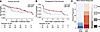
Loss of tumor-infiltrating lymphocytes and poor response to immunotherapy in IDH GOF mutant melanoma
Abstract
Recent innovations in melanoma treatment with immune checkpoint blockade (ICB) have improved overall outcomes for patients; however, over 50% of patients still develop resistance to treatment. These patients either have intrinsic resistance and never respond to therapy or develop acquired resistance months or years into treatment. The mechanisms underlying ICB resistance remain poorly understood. Our data show that patients with isocitrate dehydrogenase gain-of-function (IDH GOF) mutant melanoma have a worse response to anti-PD1 immunotherapy. IDH mutations have been found to be oncogenic and associated with differential methylation in multiple cancers but are not yet characterized in human melanoma. Here, we investigate the clinical, immune, and transcriptional phenotypes of IDH GOF melanomas through analyses of clinical response, single-cell RNA-seq, bulk RNA-seq, and DNA methylation data. Single-cell data analysis showed decreased immune infiltrate and activity in the IDH GOF tumors. Bulk sequencing data demonstrated the association among IDH mutation, immune exclusion, and disruptions in global DNA methylation. The melanoma-derived genomic data presented support previously described resistance mechanisms of IDH mutation in other cancer types and is the first demonstration to our knowledge of the role of IDH GOF in the human melanoma tumor microenvironment.
Authors
Emma Specht, Lakshmi Pakanati, Meng-Ju Wu, Russell W. Jenkins, Derek N. Effiom, Nabeel Bardeesy, Bradley E. Bernstein, Moshe Sade-Feldman, Christine G. Lian, Genevieve M. Boland, Elena Torlai Triglia, Sonia Cohen
This file is in Adobe Acrobat (PDF) format. If you have not installed and configured the Adobe Acrobat Reader on your system.
Having trouble reading a PDF?
PDFs are designed to be printed out and read, but if you prefer to read them online, you may find it easier if you increase the view size to 125%.
Having trouble saving a PDF?
Many versions of the free Acrobat Reader do not allow Save. You must instead save the PDF from the JCI Online page you downloaded it from. PC users: Right-click on the Download link and choose the option that says something like "Save Link As...". Mac users should hold the mouse button down on the link to get these same options.
Having trouble printing a PDF?
- Try printing one page at a time or to a newer printer.
- Try saving the file to disk before printing rather than opening it "on the fly." This requires that you configure your browser to "Save" rather than "Launch Application" for the file type "application/pdf", and can usually be done in the "Helper Applications" options.
- Make sure you are using the latest version of Adobe's Acrobat Reader.


