
Abstract
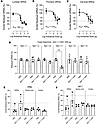
Genome-targeting strategies to address NaV1.7-mediated signaling in nociceptive afferents are of great clinical interest given its high selectivity and persistent analgesic outcomes. In the present work, we analyze concentration-dependent effects of suppressing primary afferent NaV1.7 using the intrathecal delivery of an antisense oligonucleotide (ASO) on pain behaviors and demonstrate that NaV1.7 ASOs are likely to modulate pain traffic by blocking afferent signaling at the dorsal root ganglion (DRG) level. Intrathecal NaV1.7 ASOs induced a concentration-dependent gradient of knockdown in DRGs (lumbar to cervical) of Scn9a mRNA and ATTO488-ProTx-II binding in small DRG neurons, and a suppression of pain behaviors initiated by mechanical compression, inflammation, and the NaV1.7 agonist OD-1. The rostro-caudal reduction in mRNA correlated with ASO distribution, with implications for dose-related analgesic profiles. Marked reduction in DRG NaV1.7 binding was seen after intrathecal delivery of an ASO optimal dose, with high selectivity for small DRG neurons. Changes in sciatic nerve NaV1.7 binding were not detected, indicating a pain traffic modulation likely happening due to a block of afferent signaling at the DRG level.
Authors
Kaue Malange, Julia Borges Paes Lemes, Briana Noble, Yuvicza Anchondo, Carlos E. Morado-Urbina, Saee Jadhav, Saurabh Yadav, Jingrui Ma, Vineet Augustine, Sara A. Dochnal, Chiraag Kambalimath, Marie Duong, Pedro Alvarez, Bethany Fitzsimmons, Curt Mazur, Holly B. Kordasiewicz, Kim Dore, Hien T. Zhao, Tony Yaksh
This file is in Adobe Acrobat (PDF) format. If you have not installed and configured the Adobe Acrobat Reader on your system.
Having trouble reading a PDF?
PDFs are designed to be printed out and read, but if you prefer to read them online, you may find it easier if you increase the view size to 125%.
Having trouble saving a PDF?
Many versions of the free Acrobat Reader do not allow Save. You must instead save the PDF from the JCI Online page you downloaded it from. PC users: Right-click on the Download link and choose the option that says something like "Save Link As...". Mac users should hold the mouse button down on the link to get these same options.
Having trouble printing a PDF?
- Try printing one page at a time or to a newer printer.
- Try saving the file to disk before printing rather than opening it "on the fly." This requires that you configure your browser to "Save" rather than "Launch Application" for the file type "application/pdf", and can usually be done in the "Helper Applications" options.
- Make sure you are using the latest version of Adobe's Acrobat Reader.


