
Abstract
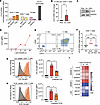
Human CD4+ T cells utilize nutrients, including lipids, to support their activation and polarization. Considering the pivotal role of lipoproteins in lipid transport, we reasoned that lipoprotein uptake and processing could effect CD4+ T cell function. Here, we demonstrate that activation of human CD4+ T cells induced expression of LDL receptor (LDLR) to facilitate LDLR-mediated endocytosis of LDL. Degradation of surface LDLR on CD4+ T cells with PCSK9 hampered activation and proliferation of the cells. Lipoprotein deprivation or blocking of lysosomal cholesterol egress impaired activation of mechanistic target of rapamycin complex 1 (mTORC1), affecting CD4+ T cell activation and proliferation. Furthermore, lipoprotein deprivation of cultured primary CD4+ T cells lead to reduced expression of c-MAF and FOXP3, key transcription factors for IL-10, accompanied by reduced IL-10 secretion. The pivotal role of LDLR-mediated lipoprotein uptake for mTORC1 activity, c-MAF and FOXP3 expression, and IL-10 secretion was confirmed using LDLR-dysfunctional CD4+ T cells from patients with homozygous familial hypercholesterolemia. Our study offers valuable insights into the lipoprotein metabolism of human CD4+ T cells and their reliance on the LDLR pathway for activation and polarization, a feature that may be leveraged to modulate CD4+ T cell function.
Authors
Angela Markovska, Niels S. van Heusden, Dagmar Duijzer, Alejandra Bodelón, Greta Rogani, Enric Mocholi, Edwin C.A. Stigter, Can Gulersonmez, Sander Kooijman, Leonie Van der Zee, Monique T. Mulder, Jeanine E. Roeters van Lennep, Patrick C.N. Rensen, Jorg van Loosdregt, Sebastiaan J. Vastert, Noam Zelcer, Marianne Boes, Henk S. Schipper
This file is in Adobe Acrobat (PDF) format. If you have not installed and configured the Adobe Acrobat Reader on your system.
Having trouble reading a PDF?
PDFs are designed to be printed out and read, but if you prefer to read them online, you may find it easier if you increase the view size to 125%.
Having trouble saving a PDF?
Many versions of the free Acrobat Reader do not allow Save. You must instead save the PDF from the JCI Online page you downloaded it from. PC users: Right-click on the Download link and choose the option that says something like "Save Link As...". Mac users should hold the mouse button down on the link to get these same options.
Having trouble printing a PDF?
- Try printing one page at a time or to a newer printer.
- Try saving the file to disk before printing rather than opening it "on the fly." This requires that you configure your browser to "Save" rather than "Launch Application" for the file type "application/pdf", and can usually be done in the "Helper Applications" options.
- Make sure you are using the latest version of Adobe's Acrobat Reader.


