
Abstract
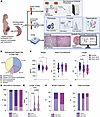
Maternal opioid use disorder (OUD) poses substantial risks to maternal and fetal health. These adverse outcomes are believed to be mediated, in part, by changes in placental structure and function; however, few studies have addressed this question. Here, we utilized flow cytometry, histology, and spatial and single-cell transcriptomics to uncover the impact of OUD on placental tissues. Given that half of individuals with chronic OUD contract hepatitis C (HCV), we further stratified our findings by maternal HCV status. Our results indicate that OUD leads to higher incidence of vascular malperfusion accompanied by increased levels of inflammatory markers and dysregulated secretion of placental development factors. Spatial transcriptomics revealed that OUD disrupts the communication between trophoblasts and immune cells important for placental vascular development. Additionally, CellChat analysis revealed aberrant vascular remodeling, neuropeptide, and chemotactic signaling across trophoblast, endothelial, and myeloid cells. Processes associated with tissue homeostasis and repair were also upregulated across trophoblasts and leukocytes. In addition, placental leukocytes were rewired toward regulatory/tissue surveillant phenotypes. Finally, frequencies and responses to ex vivo stimulation of decidual macrophages and cytolytic NK cells, critical for tissue remodeling and fetal tolerance, were decreased. Altogether, these results highlight substantial disruptions to placental health by maternal OUD.
Authors
Heather E. True, Brianna M. Doratt, Sheridan B. Wagner, Delphine C. Malherbe, Nathan R. Shelman, Mahdi Eskandarian Boroujeni, Cynthia Cockerham, John M. O’Brien, Ilhem Messaoudi
This file is in Adobe Acrobat (PDF) format. If you have not installed and configured the Adobe Acrobat Reader on your system.
Having trouble reading a PDF?
PDFs are designed to be printed out and read, but if you prefer to read them online, you may find it easier if you increase the view size to 125%.
Having trouble saving a PDF?
Many versions of the free Acrobat Reader do not allow Save. You must instead save the PDF from the JCI Online page you downloaded it from. PC users: Right-click on the Download link and choose the option that says something like "Save Link As...". Mac users should hold the mouse button down on the link to get these same options.
Having trouble printing a PDF?
- Try printing one page at a time or to a newer printer.
- Try saving the file to disk before printing rather than opening it "on the fly." This requires that you configure your browser to "Save" rather than "Launch Application" for the file type "application/pdf", and can usually be done in the "Helper Applications" options.
- Make sure you are using the latest version of Adobe's Acrobat Reader.


