
Abstract
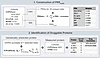
BACKGROUND We constructed multi-trait polygenic risk scores (PRSs) predicting chronic obstructive pulmonary disease (COPD) and exacerbations, validated their performance in diverse cohorts, and identified PRS-related proteins for potential therapeutic targeting.METHODS PRSmix+, a multi-trait PRS framework, is used to train a composite PRS (PRSmulti) in COPDGene non-Hispanic White participants (n = 6,647). Associations of PRSmulti with COPD status (GOLD 2–4 vs. GOLD 0 or ICD) and exacerbation frequency were tested in COPDGene African American (n = 2,466), ECLIPSE (n = 1,858), Mass General Brigham Biobank (n = 15,152), and All of Us (n = 118,566). Protein prediction models were applied to GWAS summary statistics from traits contributing to PRSmulti and were validated with proteomic data in COPDGene (n = 5,173) and UK Biobank (n = 5,012).RESULTS PRSmix+ selected 7 traits for PRSmulti. In multivariable models, PRSmulti was associated with COPD status (meta-analysis random effects [RE] OR 1.58 [95% CI: 1.28–1.94]) and exacerbation frequency (meta-analysis RE β 0.21 [95% CI: 0.11–0.31]), with higher effect sizes observed in smoking-enriched cohorts. PRSmulti outperformed traditional single-trait PRS in all tested cohorts. Using protein prediction models, we identified 73 proteins associated with the PRSs that were also validated with measured protein levels in COPDGene and UK Biobank. Of these proteins, 25 were linked to approved or investigational drugs. Notable targets include RAGE/sRAGE, IL1RL1, and SCARF2, all implicated in COPD pathogenesis and exacerbations.CONCLUSIONS Multi-trait PRS improves prediction of COPD and exacerbation risk. Integration with proteomic data identifies druggable protein targets, offering a promising avenue for precision medicine in COPD management.TRIAL REGISTRATION COPDGene: ClinicalTrials.gov NCT00608764; ECLIPSE: ClinicalTrials.gov NCT00292552.
Authors
Chengyue Zhang, Iain R. Konigsberg, Yixuan He, Jingzhou Zhang, Tinashe Chikowore, William B. Feldman, Xiaowei Hu, Yi Ding, Bogdan Pasaniuc, Diana Chang, Qingwen Chen, Jessica A. Lasky-Su, Julian Hecker, Martin D. Tobin, Jing Chen, Sean Kalra, Katherine A. Pratte, Hae Kyung Im, Emily S. Wan, Ani Manichaikul, Edwin K. Silverman, Russell P. Bowler, Leslie A. Lange, Victor E. Ortega, Alicia R. Martin, Michael H. Cho, Matthew R. Moll
This file is in Adobe Acrobat (PDF) format. If you have not installed and configured the Adobe Acrobat Reader on your system.
Having trouble reading a PDF?
PDFs are designed to be printed out and read, but if you prefer to read them online, you may find it easier if you increase the view size to 125%.
Having trouble saving a PDF?
Many versions of the free Acrobat Reader do not allow Save. You must instead save the PDF from the JCI Online page you downloaded it from. PC users: Right-click on the Download link and choose the option that says something like "Save Link As...". Mac users should hold the mouse button down on the link to get these same options.
Having trouble printing a PDF?
- Try printing one page at a time or to a newer printer.
- Try saving the file to disk before printing rather than opening it "on the fly." This requires that you configure your browser to "Save" rather than "Launch Application" for the file type "application/pdf", and can usually be done in the "Helper Applications" options.
- Make sure you are using the latest version of Adobe's Acrobat Reader.


