
Abstract
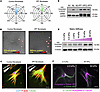
Matrix stiffening sustains fibrosis by recruiting fibroblasts to stiff fibrotic areas through durotaxis. Once recruited, fibroblasts become mechanically activated and promote scar formation. Although actin-based mechanotransduction and focal adhesion signaling are well established, how microtubules contribute to stiffness sensing and fibroblast activation in fibrosis remains incompletely understood. Here, we identify αTAT1-mediated microtubule acetylation as a key regulator of fibroblast mechanosensing, durotaxis, and profibrotic activation. Through α-tubulin K40 acetylation, αTAT1 promotes microtubule flexibility, directional alignment, and persistent polarity along stiffness gradients, thereby enabling stiffness-directed migration and fibroblast activation. Mechanistically, αTAT1-dependent microtubule acetylation regulates focal adhesion dynamics and downstream mechanotransduction. αTAT1 loss abolishes K40 acetylation, impairs FAK-mediated YAP/TAZ signaling, and prevents stiffness- and TGF-β–induced myofibroblast differentiation. Accordingly, global or fibroblast-specific Atat1 depletion reduces fibroblast durotaxis and the accumulation of profibrotic fibroblasts, protecting mice from lung, dermal, and kidney fibrosis without affecting inflammation or vascular integrity. Our findings establish αTAT1-dependent microtubule acetylation as a conserved mechanosensing pathway that links fibroblast durotaxis and activation to fibrosis across organs in vivo, and identify αTAT1 catalytic activity as a potential mechano-therapeutic target in fibrotic disease.
Authors
Alba Santos, Tamanna Islam, Maria-Anna Chrysovergi, Paula E. Grasberger, Vera Auernheimer, Taslim A. Al-Hilal, Santiago Lamas, David Lagares
This file is in Adobe Acrobat (PDF) format. If you have not installed and configured the Adobe Acrobat Reader on your system.
Having trouble reading a PDF?
PDFs are designed to be printed out and read, but if you prefer to read them online, you may find it easier if you increase the view size to 125%.
Having trouble saving a PDF?
Many versions of the free Acrobat Reader do not allow Save. You must instead save the PDF from the JCI Online page you downloaded it from. PC users: Right-click on the Download link and choose the option that says something like "Save Link As...". Mac users should hold the mouse button down on the link to get these same options.
Having trouble printing a PDF?
- Try printing one page at a time or to a newer printer.
- Try saving the file to disk before printing rather than opening it "on the fly." This requires that you configure your browser to "Save" rather than "Launch Application" for the file type "application/pdf", and can usually be done in the "Helper Applications" options.
- Make sure you are using the latest version of Adobe's Acrobat Reader.


