
Abstract
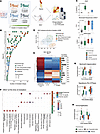
Community-acquired pneumonia is a major cause of morbidity and mortality globally. Specific molecular endotypes are currently not well defined, and different viral or bacterial pathogens may trigger specific host responses and pathogenic mechanisms. We performed longitudinal proteomic profiling of bronchoalveolar lavage fluid and plasma from bacterial, influenza, and SARS-CoV-2–driven pneumonia. Our analysis revealed highly pneumonia type–specific proteomic signatures, including COVID-19–specific antibodies locally produced in the lung. These antibodies showed biased immunoglobulin V–domain usage, linked to a CD69/CD83 plasma cell state associated with disease severity and degree of autoimmunity. Using mass spectrometry–driven autoantibody profiling in 2 independent COVID-19 cohorts, we identified 177 putative autoantibodies targeting extracellular matrix, nuclear, and immune-related proteins. Of note, temporal changes in autoantibody profiles correlated with clinical markers of inflammation, organ dysfunction, and duration of hospitalization. These findings highlight the autoimmune aspects of COVID-19 and provide potential biomarkers and therapeutic targets to help improve patient outcomes.
Authors
Anna Semenova, Taylor A. Poor, Johannes B. Müller-Reif, Sai Rama Sridatta Prakki, Phillip Geyer, Martin Mück-Häusl, Rogan A. Grant, Luke Rasmussen, Lesca M. Holdt, Daniel Teupser, Matthias Mann, Ali Ö. Yildirim, Richard G. Wunderink, Alexander V. Misharin, Ben D. Singer, G.R. Scott Budinger, Theodore S. Kapellos, Herbert B. Schiller
This file is in Adobe Acrobat (PDF) format. If you have not installed and configured the Adobe Acrobat Reader on your system.
Having trouble reading a PDF?
PDFs are designed to be printed out and read, but if you prefer to read them online, you may find it easier if you increase the view size to 125%.
Having trouble saving a PDF?
Many versions of the free Acrobat Reader do not allow Save. You must instead save the PDF from the JCI Online page you downloaded it from. PC users: Right-click on the Download link and choose the option that says something like "Save Link As...". Mac users should hold the mouse button down on the link to get these same options.
Having trouble printing a PDF?
- Try printing one page at a time or to a newer printer.
- Try saving the file to disk before printing rather than opening it "on the fly." This requires that you configure your browser to "Save" rather than "Launch Application" for the file type "application/pdf", and can usually be done in the "Helper Applications" options.
- Make sure you are using the latest version of Adobe's Acrobat Reader.


