
Abstract
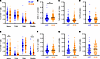
BACKGROUND Coccidioidomycosis ranges from self-limiting uncomplicated Valley fever (UVF) in most cases to life-threatening disseminated coccidioidomycosis (DCM) in rare individuals. A few patterns of immunologic deficits allowing for dissemination have been identified, although the specific defects in most individuals with DCM remain undefined. We hypothesized that chronic antigen exposure in DCM engenders a state of T cell exhaustion.METHODS From a cohort of over 300 individuals with confirmed diagnoses of coccidioidomycosis, circulating T cell phenotypes were characterized via flow cytometry and Coccidioides-specific T cell responses were measured by activation-induced marker (AIM) assay.RESULTS Male sex was significantly associated with disseminated disease (OR 2.5, 95% CI 1.5–4.0). A majority (52%) of individuals showed Coccidioides-specific T cell responses in our AIM assay. We noted a significant difference in patients sampled in the first year of diagnosis, where only 8% of patients with DCM had T cell responses during this time, as compared with 44% of individuals with UVF (P = 0.04). Among DCM patients with detectable AIM responses, CD4+ T cells demonstrated an exhausted phenotype with elevated PD-1 expression compared with UVF individuals. In vitro PD-1 blockade augmented IFN-γ production in most tested individuals with DCM.CONCLUSION These findings suggest that dissemination may occur in some individuals during a period of impaired antigen-specific T cell activity. Importantly, these responses can be augmented in vitro by PD-1–blocking antibodies, supporting further study of immune checkpoint therapy as an adjunct to antifungal treatment in disseminated coccidioidomycosis.FUNDING National Institute of Allergy and Infectious Diseases grants U19 AI166059 and R21 AI149654 and University of California Office of the President grant VFR-19-633386.
Authors
Gregory D. Whitehill, Alexis V. Stephens, Timothy J. Thauland, Miguel A. Moreno Lastre, Matthew M. Tate, Sinem Beyhan, Royce H. Johnson, George R. Thompson III, Maria Garcia-Lloret, Manish J. Butte
This file is in Adobe Acrobat (PDF) format. If you have not installed and configured the Adobe Acrobat Reader on your system.
Having trouble reading a PDF?
PDFs are designed to be printed out and read, but if you prefer to read them online, you may find it easier if you increase the view size to 125%.
Having trouble saving a PDF?
Many versions of the free Acrobat Reader do not allow Save. You must instead save the PDF from the JCI Online page you downloaded it from. PC users: Right-click on the Download link and choose the option that says something like "Save Link As...". Mac users should hold the mouse button down on the link to get these same options.
Having trouble printing a PDF?
- Try printing one page at a time or to a newer printer.
- Try saving the file to disk before printing rather than opening it "on the fly." This requires that you configure your browser to "Save" rather than "Launch Application" for the file type "application/pdf", and can usually be done in the "Helper Applications" options.
- Make sure you are using the latest version of Adobe's Acrobat Reader.


