
Submit a comment
Abstract
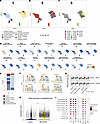
Systemic sclerosis (SSc) is characterized by fibrosis and vasculopathy affecting the skin and internal organs, leading to multiorgan dysfunction. Injury of microvascular endothelial cells (ECs) in SSc impairs blood flow and causes tissue ischemia, leading to vascular complications such as Raynaud’s, digital ulcers, and pulmonary hypertension (PH). PH in SSc presents as group 1 pulmonary arterial hypertension or as group 3 PH related to hypoxia and interstitial lung disease (ILD), both major causes of mortality. Analysis of multiome data from SSc ILD-PH lungs inferred transcription factors regulating EC phenotype, including FOSL2. Overexpression of FOSL2 in transgenic mice (Fosl2tg) leads to vascular changes mirroring human SSc-PH, such as intimal thickening and fibrosis. scRNA-Seq analysis of altered EC gene expression in Fosl2tg mice showed strong overlap with altered EC gene expression in SSc-ILD-PH. Overlapping as well as discrete EC gene expression in Sugen/hypoxia- and hypoxia-treated mice suggested that FOSL2 regulates both hypoxia-dependent and -independent pathways in Fosl2tg mice and SSc-ILD-PH. A deep learning model, ChromBPNet, inferred increased AP-1 binding at base pair resolution in SSc-ILD-PH ECs, and binding to the same motifs was found upon FOSL2 overexpression in primary vascular ECs, highlighting FOSL2’s key role in driving the pathological changes seen in SSc-ILD-PH.
Authors
Rithika Behera, Yuechen Zhou, Peter H. Gerges, Jingyu Fan, Tracy Tabib, Alyxzandria M. Gaydosik, Mengqi Huang, Jishnu Das, Elena Pachera, Amela Hukara, Ying Tang, Florian Renoux, Miranda Tai, Oliver Distler, Gabriela Kania, Stephen Y. Chan, Harinder Singh, Eleanor Valenzi, Robert Lafyatis
Guidelines
The Editorial Board will only consider comments that are deemed relevant and of interest to readers. The Journal will not post data that have not been subjected to peer review; or a comment that is essentially a reiteration of another comment.
- Comments appear on the Journal’s website and are linked from the original article’s web page.
- Authors are notified by email if their comments are posted.
- The Journal reserves the right to edit comments for length and clarity.
- No appeals will be considered.
- Comments are not indexed in PubMed.
Specific requirements
- Maximum length, 400 words
- Entered as plain text or HTML
- Author’s name and email address, to be posted with the comment
- Declaration of all potential conflicts of interest (even if these are not ultimately posted); see the Journal’s conflict-of-interest policy
- Comments may not include figures


