
Submit a comment
Abstract
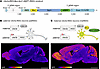
Angelman syndrome is a neurodevelopmental disorder caused by loss of the maternal UBE3A allele, the sole source of UBE3A in mature neurons owing to epigenetic silencing of the paternal allele. Although emerging therapies are being developed to restore UBE3A expression by activating the dormant paternal UBE3A allele, existing mouse models for such preclinical studies have limited throughput and utility, creating bottlenecks for both in vitro therapeutic screening and in vivo characterization. To address this, we developed the Ube3a-INSG dual-reporter knockin mouse, in which an IRES-Nanoluciferase-T2A-Sun1-sfGFP (INSG) cassette was inserted downstream of the endogenous Ube3a stop codon. The INSG model preserves UBE3A protein levels and function while enabling 2 complementary allele-specific readouts: Sun1-sfGFP and Nanoluciferase. We show that Sun1-sfGFP, a nuclear envelope–localized reporter, enables single-cell fluorescence analysis, whole-brain light-sheet imaging, and nuclear quantification by flow cytometry. Further, Nanoluciferase supports high-throughput luminescence assays for sensitive pharmacological profiling in cultured neurons and noninvasive in vivo bioluminescence imaging for pharmacodynamic assessment. By combining scalable screening, cellular analysis, and real-time in vivo monitoring in a single model, the Ube3a-INSG dual-reporter mouse provides a powerful platform to accelerate therapeutic development centered on UBE3A.
Authors
Hanna Vihma, Lucas M. James, Hannah C. Nourie, Audrey L. Smith, Siyuan Liang, Carlee A. Friar, Tasmai Vulli, Lei Xing, Dale O. Cowley, Alain C. Burette, Benjamin D. Philpot
Guidelines
The Editorial Board will only consider comments that are deemed relevant and of interest to readers. The Journal will not post data that have not been subjected to peer review; or a comment that is essentially a reiteration of another comment.
- Comments appear on the Journal’s website and are linked from the original article’s web page.
- Authors are notified by email if their comments are posted.
- The Journal reserves the right to edit comments for length and clarity.
- No appeals will be considered.
- Comments are not indexed in PubMed.
Specific requirements
- Maximum length, 400 words
- Entered as plain text or HTML
- Author’s name and email address, to be posted with the comment
- Declaration of all potential conflicts of interest (even if these are not ultimately posted); see the Journal’s conflict-of-interest policy
- Comments may not include figures


