
Submit a comment
Abstract
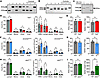
Clonal hematopoiesis of indeterminate potential (CHIP) is the expansion of blood stem cells and progeny after somatic mutation. CHIP associates with increased cardiovascular disease (CVD), with inflammation from macrophages a proposed common effector. However, mouse CHIP studies are discordant for clonal expansion and inflammation. Similarly, directionality of association between CHIP and CVD remains debated. We investigated effects of 3 CHIP mutations on macrophage cytokines, clonal expansion, and atherosclerosis in parallel. We found that cytokine release and inflammasome activation are increased by Tet2 mutation but decreased by Dnmt3a. However, Jak2 mutant macrophages produced equivalent cytokine as WT. In mice, Tet2 mutants clonally expanded, but Dnmt3a and Jak2 mutants did not. Expansion was unaffected by systemic inflammation, while hyperlipidemia expanded Tet2–/– cells but not mono-allelic mutants. Similarly, human Mendelian randomization showed no effect of serum cytokines or CVD on CHIP risk. Experimental atherosclerosis was increased in females with Tet2 and males with Jak2, but it was unchanged with Dnmt3a mutations. Together, common CHIP mutations have disparate effects on macrophage cytokines and clonal expansion, and they have sex-dependent effects on atherogenesis, suggesting a common mechanism across CHIP is unlikely. Thus, CHIP mutations differ in pathophysiology and clinical sequelae across sexes and should be treated as different entities.
Authors
Paul R. Carter, Lauren Kitt, Amanda C. Rodgers, Nichola Figg, Ang Zhou, Chengrui Zhu, Ziyang Wang, Peter Libby, Stephen Burgess, George S. Vassiliou, Murray C.H. Clarke
Guidelines
The Editorial Board will only consider comments that are deemed relevant and of interest to readers. The Journal will not post data that have not been subjected to peer review; or a comment that is essentially a reiteration of another comment.
- Comments appear on the Journal’s website and are linked from the original article’s web page.
- Authors are notified by email if their comments are posted.
- The Journal reserves the right to edit comments for length and clarity.
- No appeals will be considered.
- Comments are not indexed in PubMed.
Specific requirements
- Maximum length, 400 words
- Entered as plain text or HTML
- Author’s name and email address, to be posted with the comment
- Declaration of all potential conflicts of interest (even if these are not ultimately posted); see the Journal’s conflict-of-interest policy
- Comments may not include figures


