
Submit a comment
Abstract
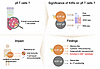
Human γδ T cells are a rare but functionally diverse lymphocyte subset critical for tumor surveillance and antimicrobial immunity. Although they express NK cell–associated receptors such as killer-cell immunoglobulin-like receptors (KIRs), the relevance of KIR expression on γδ T cells remains largely unexplored. Using flow cytometry, ATAC-seq, and RNA-seq, we identified KIR expression as a marker that distinguished 2 functionally and molecularly distinct γδ T cell subsets. KIR+ γδ T cells exhibited an advanced, memory-like differentiation state characterized by heightened cytotoxicity, stable epigenetic remodeling, and a predominant IFN-γ–producing profile. In contrast, KIR– γδ T cells maintained a naive-like phenotype and preferentially produced IL-17 upon polarization. Notably, KIR+ γδ T cells were consistently observed across individuals but were significantly enriched in cytomegalovirus (CMV)-seropositive donors, suggesting that chronic antigenic stimulation could promote the emergence of KIR+ effector γδ T cells. These findings reveal a functional dichotomy in human γδ T cells defined by KIR expression, linking IFN-γ–driven cytotoxicity with KIR+ cells and IL-17 production with KIR– cells. This insight advances our understanding of γδ T cell heterogeneity and has implications for viral immunity, immune memory, and the development of γδ T cell–based immunotherapies.
Authors
Mahya Razmi, Yeganeh Almasi, Marilee Larrivée, Jonathan B. Angel, Alexandre Blais, Zakia Djaoud
Guidelines
The Editorial Board will only consider comments that are deemed relevant and of interest to readers. The Journal will not post data that have not been subjected to peer review; or a comment that is essentially a reiteration of another comment.
- Comments appear on the Journal’s website and are linked from the original article’s web page.
- Authors are notified by email if their comments are posted.
- The Journal reserves the right to edit comments for length and clarity.
- No appeals will be considered.
- Comments are not indexed in PubMed.
Specific requirements
- Maximum length, 400 words
- Entered as plain text or HTML
- Author’s name and email address, to be posted with the comment
- Declaration of all potential conflicts of interest (even if these are not ultimately posted); see the Journal’s conflict-of-interest policy
- Comments may not include figures


