
Abstract
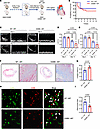
Heart failure (HF) persists as the primary cause of death among patients recovering from acute myocardial infarction (AMI). Protein ubiquitination has been implicated as a key modulator of HF pathogenesis, yet the role of ubiquitination in the Aldh2 rs671 mutant — the most common single-nucleotide variant in human populations — remains poorly understood. We discovered TRIM21 as a previously unrecognized E3 ubiquitin ligase for the ALDH2 rs671 mutant and elucidated its mechanistic involvement in HF progression. Using Aldh2 BM chimeric mice to model AMI, we observed that WT mice transplanted with Aldh2 rs671 donor BM developed severe myocardial fibrosis and markedly reduced cardiac systolic function 2 weeks after infarction compared with controls. This phenotype arose from defective macrophage efferocytosis caused by myeloid-specific Aldh2 rs671 mutation. Through high-resolution mass spectrometry proteomics, we identified TRIM21 as the E3 ligase targeting ALDH2. TRIM21 catalyzed K48-linked ubiquitination at ALDH2 lysine 73. Macrophage-specific Trim21 knockdown via AAV-shTrim21 reversed both the exacerbated cardiac fibrosis and systolic dysfunction by restoring macrophage efferocytosis. These findings delineate the upstream E3 ubiquitin ligase and the ubiquitination site of ALDH2, revealing a potential therapeutic target for HF.
Authors
Tianrui Han, Xin Wen, Yunyun Guo, Xiangkai Zhao, Jian Zhang, Yuguo Chen, Feng Xu
This file is in Adobe Acrobat (PDF) format. If you have not installed and configured the Adobe Acrobat Reader on your system.
Having trouble reading a PDF?
PDFs are designed to be printed out and read, but if you prefer to read them online, you may find it easier if you increase the view size to 125%.
Having trouble saving a PDF?
Many versions of the free Acrobat Reader do not allow Save. You must instead save the PDF from the JCI Online page you downloaded it from. PC users: Right-click on the Download link and choose the option that says something like "Save Link As...". Mac users should hold the mouse button down on the link to get these same options.
Having trouble printing a PDF?
- Try printing one page at a time or to a newer printer.
- Try saving the file to disk before printing rather than opening it "on the fly." This requires that you configure your browser to "Save" rather than "Launch Application" for the file type "application/pdf", and can usually be done in the "Helper Applications" options.
- Make sure you are using the latest version of Adobe's Acrobat Reader.


