
Abstract
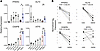
Mycobacterium tuberculosis (Mtb) survives within multiple macrophage populations during infection, including alveolar macrophages (AMs) and recruited inflammatory macrophages. In mice, itaconate, produced in macrophages by ACOD1-mediated decarboxylation of aconitate, has direct antimicrobial activity, modulates inflammatory cytokines, and is required for resistance to Mtb infection. The role of itaconate in human macrophages is less clear, and it is unknown whether itaconate mediates distinct effects in macrophage subtypes. Here, we investigated the role of itaconate in macrophages derived from human induced pluripotent stem cells (iPSCs), induced by either GM-CSF to resemble AMs (AM-like cells, hereafter ipAM-Ls) or M-CSF to resemble monocyte-derived macrophages (MDM-like cells, hereafter ipMDM-Ls). Both human macrophage types produced substantially less itaconate than mouse macrophages, and ipAM-Ls produced 4-fold less itaconate than ipMDM-Ls. Surprisingly, ACOD1-deficient ipAM-Ls, but not ipMDM-Ls, were permissive for Mtb growth. Moreover, itaconate functioned to dampen the Mtb-induced inflammatory response in ipMDM-Ls, but not ipAM-Ls, affecting both the type I IFN and TNF pathways. These results indicate that itaconate is involved in human macrophage responses to tuberculosis, with distinct roles in different macrophage subsets. These results also show that genetically tractable iPSC-derived macrophages are a useful model to dissect cellular host-pathogen interactions in human macrophages.
Authors
Adam S. Krebs, Tomi Lazarov, Anthony T. Reynolds, Kimberly A. Dill-McFarland, Abigail Xie, James M. Bean, Muxue Du, Olivier Levy, John A. Buglino, Aaron Zhong, Anna-Lena Neehus, Stéphanie Boisson-Dupuis, Jean-Laurent Casanova, Elouise E. Kroon, Marlo Möller, Thomas R. Hawn, Ting Zhou, Lydia W.S. Finley, Marc Antoine Jean Juste, Dan W. Fitzgerald, Frederic Geissmann, Michael S. Glickman
This file is in Adobe Acrobat (PDF) format. If you have not installed and configured the Adobe Acrobat Reader on your system.
Having trouble reading a PDF?
PDFs are designed to be printed out and read, but if you prefer to read them online, you may find it easier if you increase the view size to 125%.
Having trouble saving a PDF?
Many versions of the free Acrobat Reader do not allow Save. You must instead save the PDF from the JCI Online page you downloaded it from. PC users: Right-click on the Download link and choose the option that says something like "Save Link As...". Mac users should hold the mouse button down on the link to get these same options.
Having trouble printing a PDF?
- Try printing one page at a time or to a newer printer.
- Try saving the file to disk before printing rather than opening it "on the fly." This requires that you configure your browser to "Save" rather than "Launch Application" for the file type "application/pdf", and can usually be done in the "Helper Applications" options.
- Make sure you are using the latest version of Adobe's Acrobat Reader.


