
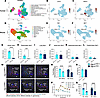
Abstract
GLP-1 receptor (GLP-1R) agonists decrease blood glucose and body weight and reduce rates of cardiovascular and renal disease. Although GLP-1R activation lowers blood pressure (BP), the underlying mechanisms remain incompletely understood and have been attributed to weight loss and endothelial cell GLP-1R signaling. Here, we show that GLP-1Rs in vascular smooth muscle cells (VSMCs) are essential for semaglutide-mediated BP reduction in mice. In contrast, GLP-1Rs in Tie2+ endothelial or immune cells are not required for semaglutide to lower BP. The VSMC GLP-1R is dispensable for the effects of semaglutide on food intake, body weight, and blood glucose but is required for its actions to increase glomerular filtration rate and promote natriuresis. Systemic semaglutide administration resulted in proteomic changes in the renal artery and kidney in pathways related to platelet aggregation, fibrin clot formation, lipid metabolism, and proapoptotic signaling that are abolished in mice lacking VSMC GLP-1R expression. Moreover, semaglutide directly induced vasorelaxation in preconstricted mesenteric arteries ex vivo. Together, these findings identify VSMCs as a key cellular target linking GLP-1R activation to BP regulation, renal electrolyte excretion, and proteomic changes in renal artery and kidney.
Authors
Kyle D. Medak, Jacqueline A. Koehler, Laurie L. Baggio, Maria J. Gonzalez-Rellan, Chi Kin Wong, Xiemin Cao, Vivikta Rao, Sean Kao, Yu Cui, Jiayi Fu, Easton Liaw, M. Golam Kabir, Jie Zhang, Jin Wei, Daniel J. Drucker
This file is in Adobe Acrobat (PDF) format. If you have not installed and configured the Adobe Acrobat Reader on your system.
Having trouble reading a PDF?
PDFs are designed to be printed out and read, but if you prefer to read them online, you may find it easier if you increase the view size to 125%.
Having trouble saving a PDF?
Many versions of the free Acrobat Reader do not allow Save. You must instead save the PDF from the JCI Online page you downloaded it from. PC users: Right-click on the Download link and choose the option that says something like "Save Link As...". Mac users should hold the mouse button down on the link to get these same options.
Having trouble printing a PDF?
- Try printing one page at a time or to a newer printer.
- Try saving the file to disk before printing rather than opening it "on the fly." This requires that you configure your browser to "Save" rather than "Launch Application" for the file type "application/pdf", and can usually be done in the "Helper Applications" options.
- Make sure you are using the latest version of Adobe's Acrobat Reader.


