
Abstract
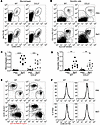
In chronic beryllium disease (CBD), elevated levels of the inflammatory chemokines CCL3 and CCL4 in the lungs coincide with expanded populations of CD4+ T cells specific to beryllium-modified (Be-modified) peptides derived from these chemokines. Here, we generated HLA-DP2 transgenic (Tg) CCL3-deficient mice (CCL3–/–) that also lack CCL4 to investigate their role in disease development. Be-exposed CCL3–/– mice maintained normal numbers of lung macrophages and dendritic cells (DCs) but exhibited significantly reduced total and HLA-DP2–CCL/Be tetramer-specific CD4+ T cells, IFN-γ–producing CD4+ T cells, and peribronchovascular aggregates, consistent with attenuated inflammation. CCL3 was predominantly expressed in macrophages and DCs, and bone marrow chimera studies confirm that hematopoietic-derived DCs are the key regulators of CCL/Be-specific CD4+ T cell responses. RNA-seq of lung-resident CCL4/Be tetramer+ CD4+ T cells revealed a transcriptional profile enriched for inflammatory and cholesterol-metabolism pathways, with elevated expression of Ifng, Tnf, and Il17a. Moreover, Be-exposed HLA-DP2 Tg mice lacking TNF-α or treated with peptide-MHCII CAR-T cells targeting CCL4/Be-specific CD4+ T cells showed reduced T cell responses and cellular aggregates. These findings demonstrate that CCL3 and CCL4 promote CCL/Be-specific CD4+ T cell responses and highlight peptide-MHCII CAR-T cells as a potentially novel strategy for depleting self-peptide/Be-specific CD4+ T cells in CBD.
Authors
Michael T. Falta, Masoom Raza, Caley J. Nevienski, Tonya M. Brunetti, Rui Fu, Rebecca M. Tucker, Joseph M. Gaballa, Faiz Minhajuddin, Kibrom M. Alula, Alberto Dinarello, Douglas G. Mack, Allison K. Martin, Joseph C. Onyiah, Michael Yarnell, Prashanth Francis, Terry J. Fry, Lisa A. Maier, Andrew P. Fontenot, Charles A. Dinarello, Shaikh M. Atif
This file is in Adobe Acrobat (PDF) format. If you have not installed and configured the Adobe Acrobat Reader on your system.
Having trouble reading a PDF?
PDFs are designed to be printed out and read, but if you prefer to read them online, you may find it easier if you increase the view size to 125%.
Having trouble saving a PDF?
Many versions of the free Acrobat Reader do not allow Save. You must instead save the PDF from the JCI Online page you downloaded it from. PC users: Right-click on the Download link and choose the option that says something like "Save Link As...". Mac users should hold the mouse button down on the link to get these same options.
Having trouble printing a PDF?
- Try printing one page at a time or to a newer printer.
- Try saving the file to disk before printing rather than opening it "on the fly." This requires that you configure your browser to "Save" rather than "Launch Application" for the file type "application/pdf", and can usually be done in the "Helper Applications" options.
- Make sure you are using the latest version of Adobe's Acrobat Reader.


